
The Angel in the Colombian Mask
Simboli del sogno
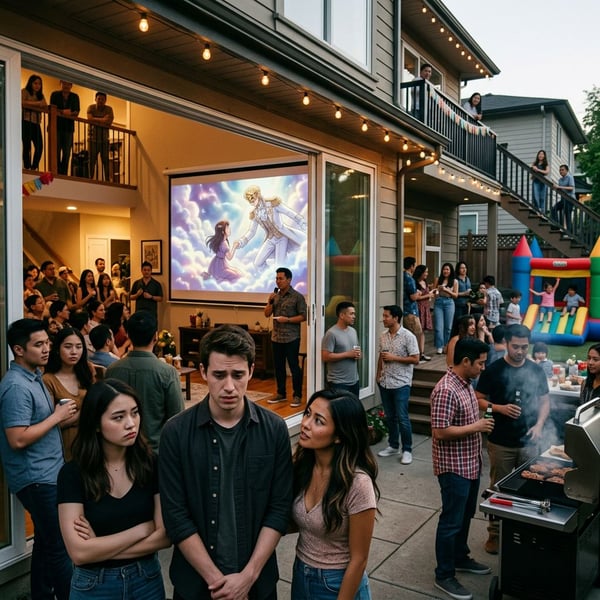
I was at a party with at least 30 people. It wasn’t your average gathering, though. It was a mix of all sorts of activities, including a big surprise event: a showcase where people presented a creative project about anything they wanted. Once again, this story involves Tiffany, along with another girl who is half Filipina and half Japanese. We’ll call her Mika for now. As I walked around talking to people, my first encounter was with Tiffany. She asked if we could spend more time together and do some of the activities she had planned. I agreed, though I let her know I wanted to finish making the rounds first to see who else was there. With a smile, she said, “OK,” and walked back into a room by herself. Even behind her smile, I could tell she was a little sad—her tone of voice gave it away. I continued exploring different floors of the house and mingling with guests until Mika walked right up to me. Even though her facial expression was as blank as paper, I could tell she had been waiting to see me again by the way she moved and how close she stood. “It’s nice to see you, Erick. I hope you’re enjoying the party and all,” she said. I nodded in agreement. “You know, Erick, there’s something I want to tell you. I don’t know how to say it, but…” she trailed off, swaying back and forth as she grew flustered, gearing up for her next line. Before she could continue, I knew what was coming. I had seen this before; she was about to confess her feelings to me. Taking advantage of her long pause, I thought of a way to excuse myself from the conversation. “Hey, excuse me, but someone needs me out on the patio deck,” I said. “I’ll be right back.” With her head tilted slightly to the side and a hint of disappointment in her face and voice, she said, “OK.” Then she looked back up at me with sudden determination and added, “Please do come back. I’ll be waiting right here for you.” I nodded and walked away. Even as I left, I could picture and feel her sadness. I made it outside and looked around. Kids were playing in a bouncy castle, guests were chatting, and a few people were grilling. For a second, I felt like I finally had a moment alone to think—until I spotted both Tiffany and Mika outside, searching for me. My heart dropped in fear. They both walked up to me, and Tiffany spoke first. “Hey, are you ready to hang out with me? I’ve been waiting for you.” Mika overheard her. “Wait, I want to hang out with you, remember? There are things I want to do and talk about with you,” Mika countered. The two of them looked at each other, suddenly competing for my attention. They tried to one-up each other by listing what an amazing person I was and how much the things I did for them meant. The exchange started drawing attention, and soon everyone around us turned their heads toward the three of us. I grew intensely nervous, not wanting a crowd to figure out what was really going on. Just then, the party host spoke into the microphone to announce the next big event—the creative showcase everyone had prepared. Looks like I dodged another bullet there, I thought to myself. Out of nowhere, Mika’s video started playing first. She had made an anime-style animation. It began by showing her early days of innocence, followed by years of being bullied at school by other girls. Little by little, the animation showed her growing cold and distant over time—until one day, a man descended from the cloudy sky bathed in light, like an angel. He had nice hair and wore all-white aristocratic attire paired with a Colombian mask. He reached out his hand and helped Mika back to her feet. In that scene, Mika looked as though she had found the energy to feel alive again—and, more importantly, to feel love. The longer I stared at the fictional character on the screen, the more I realized it was me. Mika’s entire presentation was about how miserable her life had been before she met me, and how I had completely changed it.
This dream seems to center on being valued, feeling responsible for other people’s feelings, and struggling to make room for your own choices. It isn’t necessarily a prediction about Tiffany or Mika; dream characters often represent real relationships, remembered interactions, or different parts of your inner life.
The party and the many activities
A party with dozens of people is a social world in miniature: lots of possible connections, expectations, and things competing for your attention. The house’s different floors may suggest that you’re moving among different parts of your social or emotional life, trying to see what’s there before deciding where to spend your time.
The creative showcase adds another layer. Everyone has a chance to present something personal to an audience. It may reflect a wish to be understood—or a concern about what might be revealed when people show what matters most to them.
Tiffany and Mika’s competing bids for your attention
Tiffany asks to spend time with you, and you agree—but first want to make the rounds. Mika approaches with something important to say, and you sense what it is before she can say it. In both cases, you’re aware of their feelings, yet you delay responding. That can point to ambivalence: wanting connection, but also wanting freedom, time to think, or protection from the expectations that come with someone’s affection.
Your sensitivity to their sadness is prominent. You notice it even when they smile or keep their words simple. The dream may be highlighting how closely you monitor other people’s emotional reactions—and how quickly their disappointment can become something you feel responsible for.
The excuse about someone needing you on the patio gives you a temporary exit, but not real relief. Both women find you there. This suggests that avoiding a difficult conversation may postpone the pressure without resolving it. The “dodged another bullet” thought sounds less like triumph than a moment of relief at escaping public exposure.
The public confrontation
When Tiffany and Mika discover each other, their private requests become a public contest. Their praise of you may feel flattering, but it also puts you under a spotlight you don’t want. The crowd’s attention intensifies the sense that you could be judged, exposed, or expected to choose.
This part may reflect discomfort with being placed in the role of the person who must manage everyone’s feelings. The dream doesn’t show you enjoying the competition; it shows you growing nervous and hoping for a way out. That may be worth noticing: being appreciated can feel complicated when it comes bundled with pressure or responsibility.
Mika’s animation and the “angel” figure
Mika’s presentation is the emotional center of the dream. It tells a story of innocence, bullying, emotional withdrawal, and then a dramatic rescue by a radiant man. When you recognize yourself in that figure, the dream gives you an image of how important you may feel in Mika’s story—or how much you fear being cast as someone’s savior.
The angel-like clothing, the light, and the hand reaching down all point toward rescue, hope, and transformation. The Colombian mask is especially striking because it combines a recognizable face or identity with something concealed. It might suggest that the figure is partly you and partly an idealized role: the person who arrives, helps, and becomes difficult to separate from the other person’s renewed sense of life and love.
That image can carry two meanings at once:
- A gratifying one: you want to matter deeply, to have helped someone feel seen or hopeful.
- A burdensome one: you may worry that someone’s wellbeing or happiness depends too heavily on you.
The animation presents Mika’s transformation as a consequence of meeting you. The dream may be asking whether you feel comfortable with that kind of significance—or whether it makes affection feel like an obligation you cannot easily decline.
A possible overall message
The dream may be bringing together two wishes that are in tension: to be loved and appreciated, and to remain free to choose how close you want to be. It also highlights a possible pattern of postponing direct responses because you don’t want to hurt anyone. Yet the dream shows that avoidance creates suspense and public pressure rather than genuine privacy.
A useful question to sit with is: When someone values you deeply, do you feel seen—or do you feel responsible for becoming the person they need you to be? The dream may be inviting you to distinguish kindness from obligation, and to consider whether honest, gentle boundaries would feel safer than trying to keep everyone from feeling disappointed.
Cosa hai sognato?
Interpreta il Sogno