
The Illusion of the "Good Guy" in Modern Society
Dream symbols
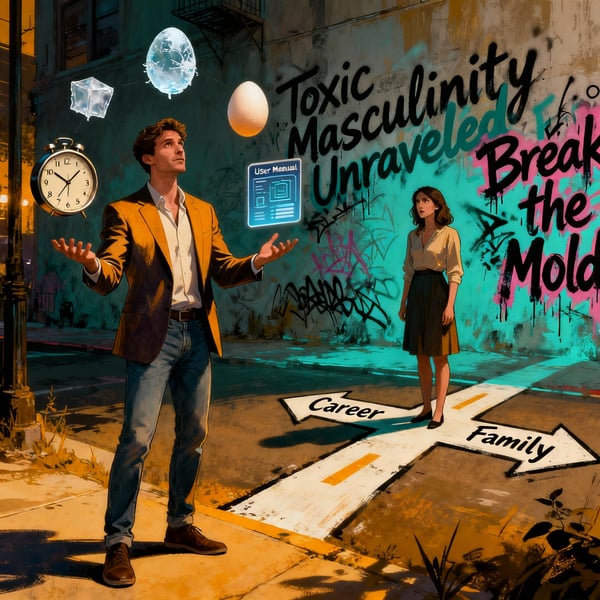
Here’s a clean, sharp take—critical, lyrical, no hand-holding, and very clear about the problem: ⸻ There’s a certain breed of funny men—the self-styled rebels of the tech age—who swear they’re anti-capitalist, anti-platform, anti-algorithm. They hate Big Tech, mock productivity culture, talk about dismantling systems over craft beer. Very avant-garde. Very hacked-together morality. And yet, somehow, their expectations for women are straight out of a dusty patriarchal user manual. They want the woman to freeze her eggs, delay her life, optimize her biology like a deprecated app—just in case. Fifty years old? No problem, science will save it. Motherhood becomes a logistical hack, a backup file stored in a cryogenic server, while his timeline remains conveniently undefined. He gets to age like “experience.” She gets to age like “risk.” Then there’s the untreated OCD—never diagnosed, never named—masked as “being chill.” Carelessness dressed up as freedom. Disorganization reframed as philosophy. Things that actually matter? Ignored. Emotional labor? Outsourced. Accountability? Deprecated. And everyone plays along because, hey, he’s a good guy. He’s not violent. He’s not a monster. He doesn’t go to war. The bar is underground, and we still applaud. Sometimes I think we all let this happen because the label good guy has become a universal excuse. A moral all-access pass. He’s not a psychopath, not a serial killer—so anything short of that gets a free pass. Meanwhile, his sexual life, shaped by endless choice and zero friction, quietly rewires him. It teaches him that time doesn’t apply to him. That youth is a resource he can always buy later. That it’s reasonable—somehow—to imagine marrying someone barely out of adolescence when he’s pushing sixty, because society keeps nodding along, calling it “preference” instead of what it is: entitlement wrapped in irony. Being a “good guy” today is the ultimate PR strategy. It covers everything. It justifies delaying women’s lives, postponing their futures, and reframing inequality as personal choice. It’s sold as kindness, but it functions like a system—smooth, efficient, and deeply unfair. A legacy model with a fresh UI. We don’t need better hacks for this system. We need to admit it’s broken. And yes, that’s the uncomfortable truth: humor doesn't pay off.
This piece is a critical commentary on certain social and cultural dynamics prevalent in today's tech-driven world, particularly regarding gender roles and expectations. Here's an interpretation breaking down the key elements and themes:
Theme Analysis
-
Hypocrisy in Anti-Capitalism:
- The dream narrative begins by highlighting a specific group of men who portray themselves as anti-establishment yet subscribe to outdated patriarchal norms. Despite their critique of "Big Tech" and platforms, their personal lives are a contradiction, as they impose antiquated expectations on women.
-
Gendered Time Constraints:
- The text criticizes the societal expectation for women to withstand the pressures of biological optimization, contrasting it with the undefined, limitless timeline afforded to men. Women's lives are portrayed like a program needing updates, while men age gracefully and without societal pressure.
-
Masked Personal Flaws:
- The narrative digs into the idea that personal shortcomings, such as untreated OCD or a degree of irresponsibility, are glamorized under the guise of being laid-back or philosophical, further perpetuating inequality by ignoring important emotional and organizational labor.
-
"Good Guy" Conundrum:
- It challenges the notion of what it means to be a "good guy" and how this label provides a moral carte blanche. The societal bar is set so low for men that merely not being a "monster" gets undue praise and acceptance, overshadowing deeper systemic issues.
-
Entitlement in Relationships:
- There's a sharp critique on how societal norms enable older men to envision relationships with significantly younger women, framing it as a choice rather than acknowledging the underlying entitlement. The concept of "preference" is criticized as a veil over inherent power imbalances.
-
PR of "Good Guy" Persona:
- Being labeled as a "good guy" is portrayed as a strategic social maneuver that shields individuals from scrutiny, allowing for perpetuation of gender biases under the guise of benevolence. This representation operates efficiently, maintaining an unjust status quo under the facade of choice.
-
Call to Action:
- The narrative concludes with a call for honest acknowledgment of these systemic issues rather than superficial fixes. The "hacks" to navigate this flawed system are inadequate, and admitting its dysfunction is presented as the first step towards genuine progress.
Conclusion
The piece serves as a wake-up call, urging readers to critically reevaluate societal norms around gender, relationships, and the superficial acceptance of "good" as sufficient. It advocates for a deeper recognition of the underlying systemic problems and a shift away from mere superficial reforms or acceptance of traditional roles. The narrative suggests a need for genuine change and acknowledgment of the ingrained biases that continue to govern interpersonal dynamics in modern society.
What did you dream?
Interpret Dream